“The face isn’t important”
Grey Bees“The face isn’t important” is Aisha’s quiet answer to Sergeyich’s question about the candles she lights for her father. Its meaning deepens when he later examines photographs of her parents: faces change, she has said, and the phrase returns to him as he struggles to recognize the people pictured. The exchange sets two forms of remembrance—ritual and photographic likeness—against a more enduring sense of a person’s presence.
The Conversation About Candles
Sergeyich asks Aisha whether she lights the candles in memory of her father and how long she intends to keep doing so. When he explains that his own people place a candle before a photograph of the deceased, he considers mentioning the accompanying glass of vodka and bread but decides that doing so might be inappropriate. His account makes remembrance concrete and domestic: a portrait, a candle, and familiar offerings arranged together.
Aisha answers his account with a distinction rather than a matching custom. “The face isn’t important,” she says first in a barely audible whisper, then repeats more loudly when Sergeyich asks what she said. She explains that Allah has no face, yet exists. When Sergeyich objects that the face of a loved one matters, Aisha shakes her head and adds, “Faces change.” Her reply shifts the conversation from how the dead are pictured to whether likeness is necessary for belief or memory.
Photographs and Changing Faces
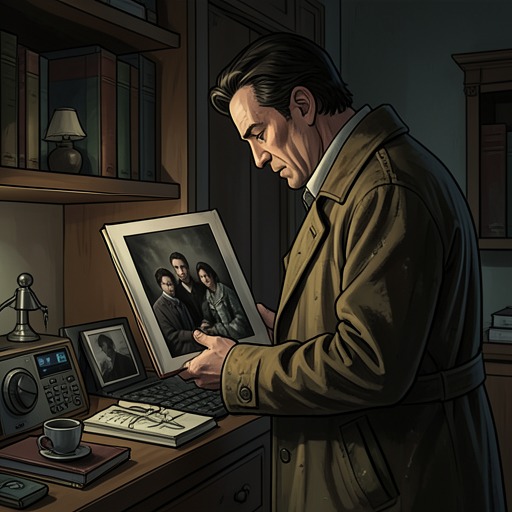
The phrase returns later as Sergeyich turns through a thick album of photographs. One picture shows Aisha’s parents, Akhtem and Aisylu, as newlyweds: Akhtem wears a blue suit and white fez; Aisylu wears a white dress gathered with a blue belt and a taller blue fez. In another, the young couple lead a horse through a field. Sergeyich looks closely at Akhtem but does not recognize him; he knows who the young man is only because he stands beside Aisylu. He also observes that Aisylu herself has changed since the photograph was taken.
That difficulty gives Aisha’s words a specific force. A photograph preserves an appearance, but it cannot guarantee immediate recognition across time. Sergeyich recalls her statement in an echoing thought—“The face isn’t important”—and begins flipping through the album more quickly, no longer studying each image so carefully. The words have not solved the problem of recognition; they have unsettled the assumption that a preserved face is the same thing as the person.
Memory and Recognition
The exchange juxtaposes Sergeyich’s familiar practice of placing a photograph beside a candle with Aisha’s insistence that faces change and need not ground remembrance. The two positions are not simply opposed: Sergeyich’s impulse is to remember through a loved one’s likeness, while Aisha points toward existence and memory beyond visible features. His hesitation over mentioning vodka also shows him measuring the customs he shares against the setting of this conversation, even as he tries to understand hers.
The phrase becomes a small interpretive key to the album scene, where recognition falters despite the photographs’ apparent promise of permanence. Sergeyich’s attention moves from the changing faces of Akhtem and Aisylu to a group photograph of roughly fifty people or more, arranged in three rows on the colonnaded steps of a white building that seems familiar to him. At that point, the phrase has prepared the reader to see photographs not as transparent access to the past but as images whose meaning depends on memory, context, and the limits of recognition.